
Spike sorting
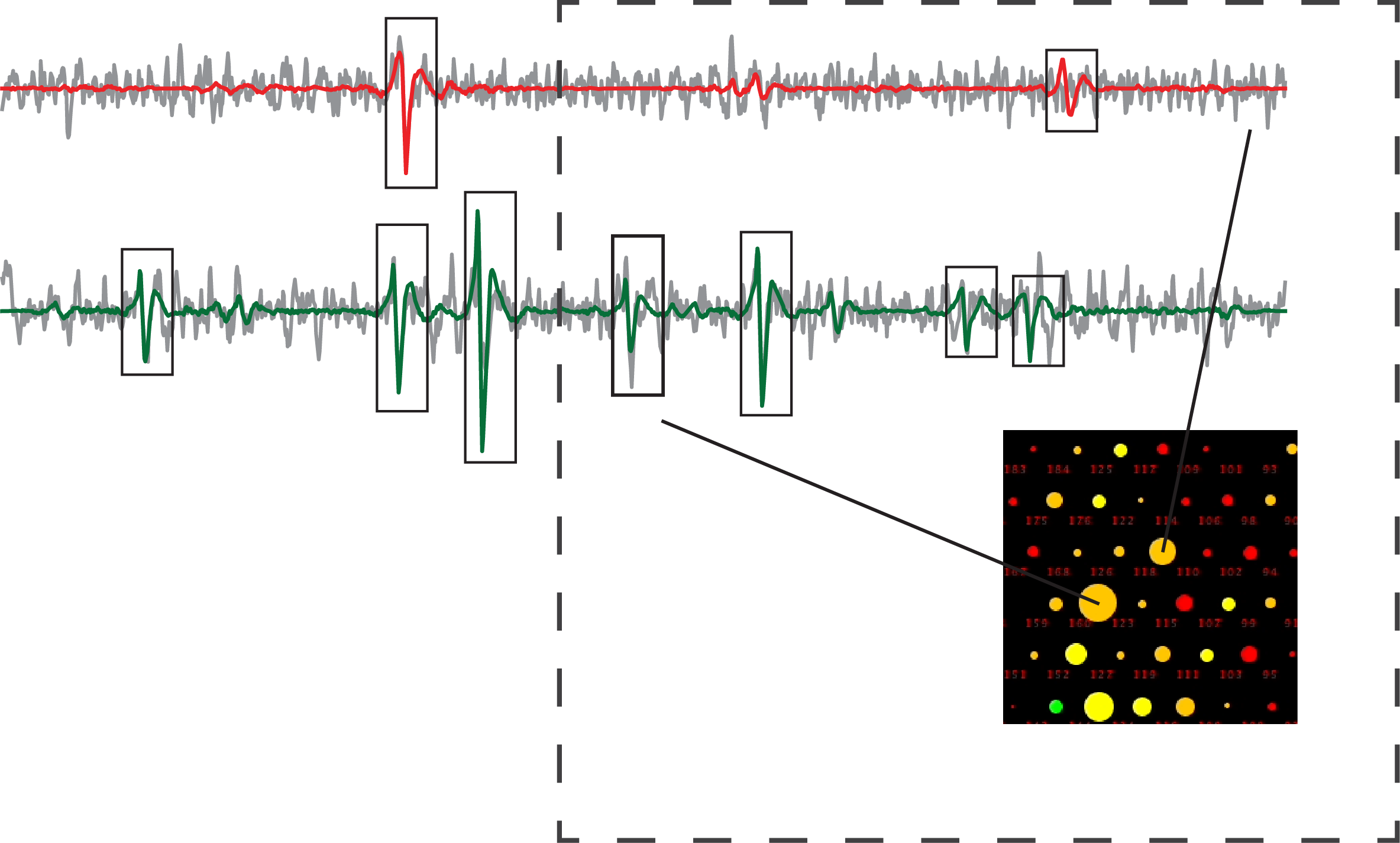
Making sense of large-scale electrophysiological data depends on the reliability with which spikes are extracted from voltage traces and accuracy with which the spikes are assigned to individual neurons. We employ spike sorting methods such as Kilosort, YASS, and Spyking Circus, for analyzing electrophysiological data. We validate these methods across different models used for vision research.
Viral vectors for targeting cell types
We work with institutional cores to design custom viral constructs for our projects. These tools enable us to target cell types for anatomical tracing, optogenetic/chemogenetic manipulation, and molecular characterization.

Light-sheet imaging
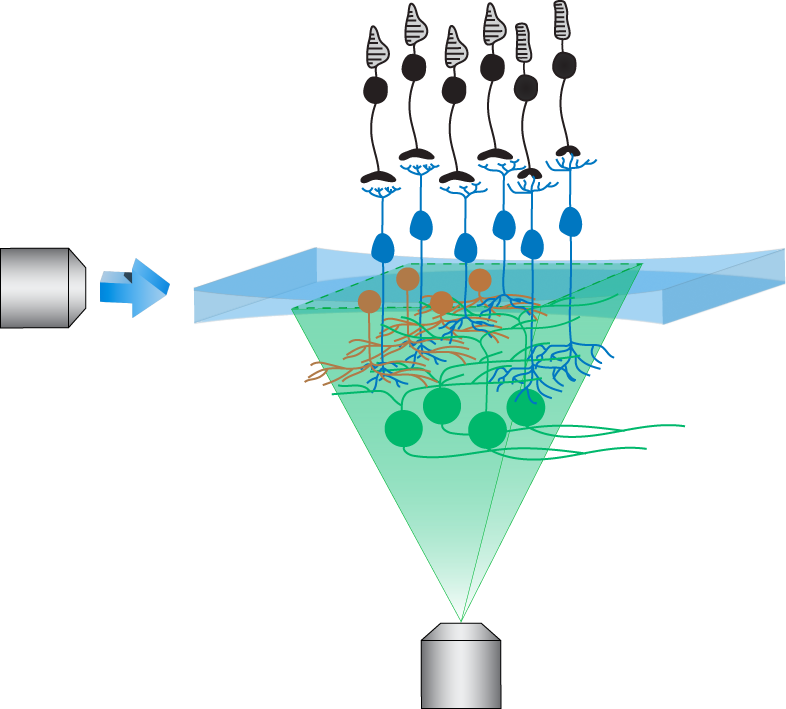
Built on principles of restricted planar imaging, light-sheet fluorescence microscopy enables measurements of neural activity at single-cell resolution across large regions of the ex vivo retina (read more). For functional characterization, we target retinal interneurons and ganglion cells for GCaMP expression. We are also refining these tools to study signal propagation within circuits, and within neuronal compartments such as dendrites and axons.
Computational modeling
The architecture and connectivity of the retina allow sophisticated computations relevant for vision. We are developing linear-nonlinear encoding and decoding models, and CNN-based models, to understand visual signaling properties in rod and cone dominated mammals.

Codebase
We continuously update our codebase for data analysis, computational modeling, and generating novel visual stimuli for experiments. Explore our work on the GitHub repository.

Designing and prototyping
We design and prototype custom components for optical setups, experimental rigs, and other lab applications. Parts are 3D printed in-house or CNC machined for use.